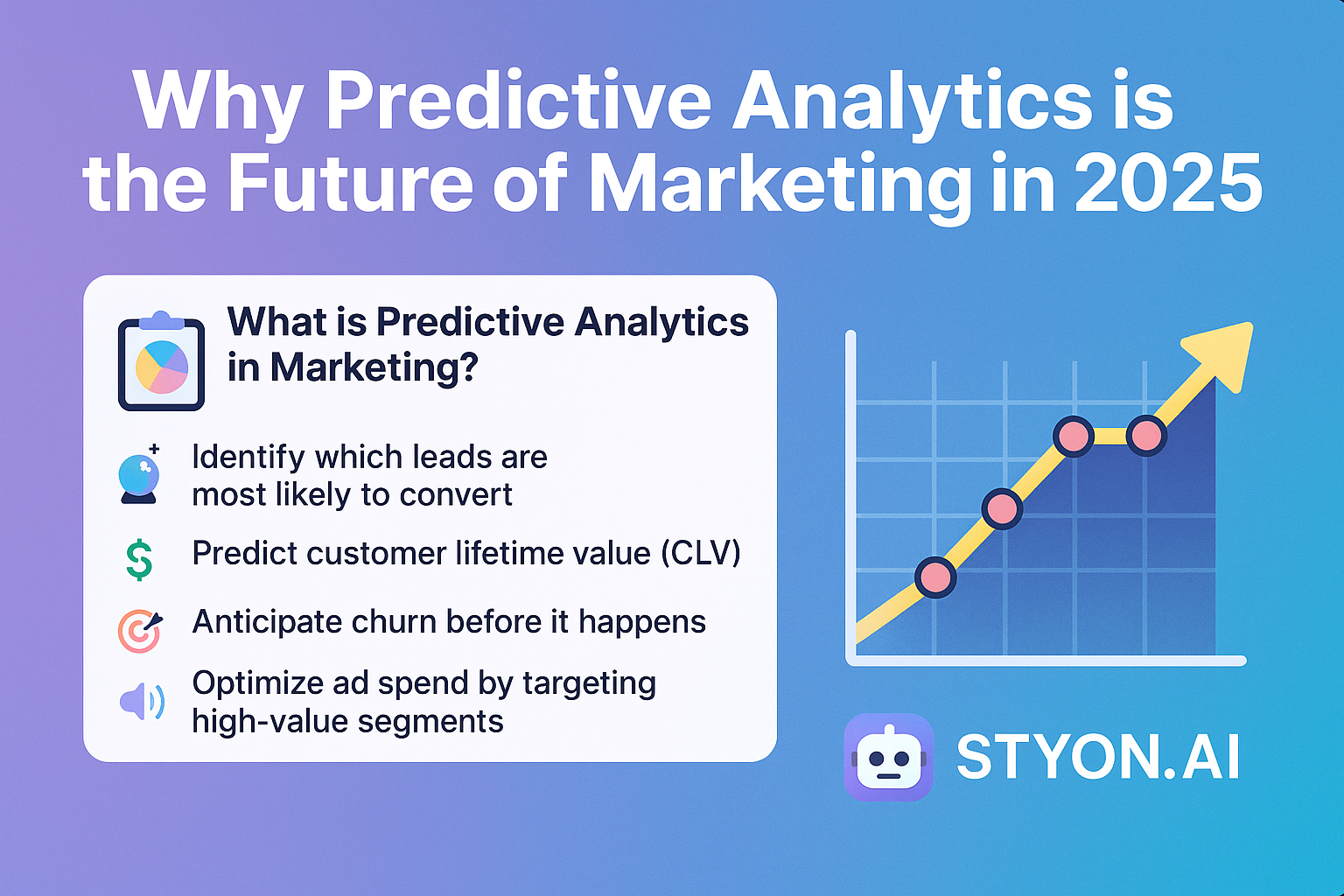
In 2025, marketing is no longer just about reacting to customer behavior — it’s about predicting it. With AI-powered predictive analytics, brands can anticipate customer needs, forecast campaign outcomes, and optimize strategies before launching them.
📊 What is Predictive Analytics in Marketing?
Predictive analytics uses historical data, machine learning, and AI to forecast future customer actions. Instead of guessing what your audience wants, you can:
-
🔮 Identify which leads are most likely to convert
-
💸 Predict customer lifetime value (CLV)
-
🎯 Anticipate churn before it happens
-
📢 Optimize ad spend by targeting high-value segments
🚀 Why It Matters in 2025
The digital landscape is oversaturated, and attention spans are shrinking. Businesses that rely only on intuition risk losing to data-driven competitors. Predictive analytics helps you:
✅ Reduce wasted ad spend
✅ Deliver personalized campaigns at scale
✅ Forecast ROI with confidence
✅ Stay ahead of customer expectations
🔧 Key Features in Styon.AI
| Feature | ✅ Supported by Styon.AI? |
|---|---|
| Predictive Lead Scoring | ✔️ Yes |
| Customer Churn Prediction | ✔️ Yes |
| Campaign Performance Forecasting | ✔️ Yes |
| Automated Audience Segmentation | ✔️ Yes |
| Real-Time Insights Dashboard | ✔️ Yes |
📈 Real-World Use Case
Imagine you run an eCommerce store:
-
Styon.AI analyzes past purchases and predicts which customers are ready for upsells
-
You receive alerts for customers at risk of churn — so you can re-engage them with a discount
-
Your ad campaigns automatically prioritize audiences with the highest conversion likelihood
The result: higher ROI, lower costs, and smarter growth.
Final Thoughts
Predictive analytics isn’t the future — it’s the present. Companies leveraging AI-driven forecasting in 2025 will outperform competitors who still rely on guesswork.